
The 45 Second Short: A Shot by Shot Edit Map Clients Actually Pay For

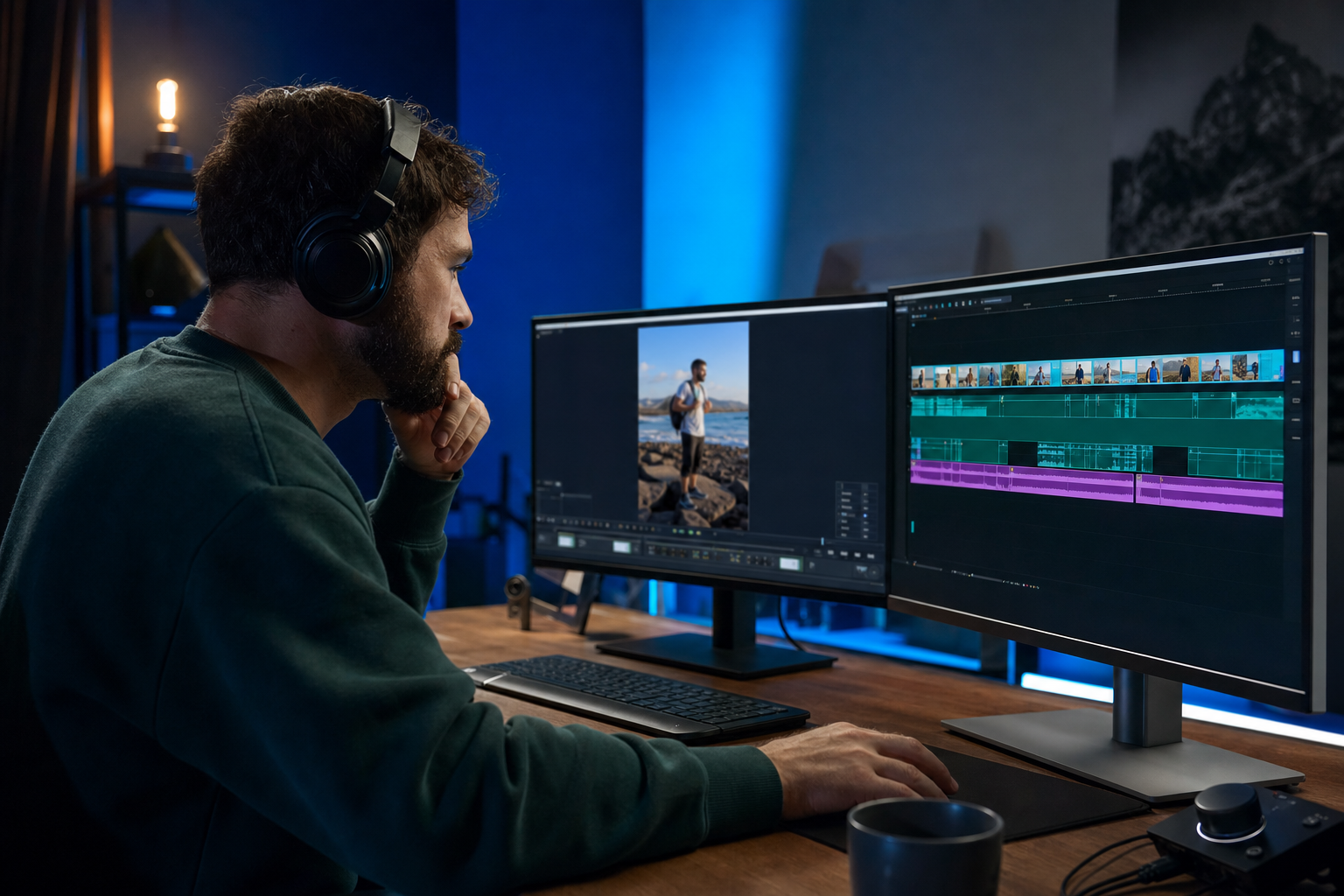
What this guide teaches: the 45 second edit map, timestamps, hooks, captions, and B roll logic, that performance marketers pay for on Reels, TikTok, and LinkedIn.
Who hires a Cinematic Synthesis Specialist: Brands need daily video; AI handles cuts, captions, and B roll while you control story and brand tone.
Plain English role: Turn raw footage and scripts into polished shorts, ads, and explainers using AI editing, b roll, captions, and pacing, without a full studio team.
The new video editor is not faster scissors, it is a storyteller who commands AI assembly lines.
Typical freelance range: $35 to 90/hour. Demand signal (2026): Exploding. Clients on Upwork and Fiverr increasingly buy deliverables (audits, templates, packs), not “I know AI.”
Time you can save a client: 6 to 12 hours per 60 second polished short when you run a tight process with CapCut AI, Runway, Descript.
The 45 second map (memorize this)
- 0:00 to 0:02, Pattern interrupt, bold claim, question, or visual jolt. No logos, no “hey guys.”
- 0:02 to 0:15, Problem, one sentence pain; b roll proves it (not wallpaper).
- 0:15 to 0:35, Proof, demo, stat, testimonial, or screen recording.
- 0:35 to 0:45, CTA, one action; on screen text mirrors the spoken line.
Platform specific caption rules
- TikTok / Reels: max ~32 characters per line; highlight keywords in brand color; safe zones for UI overlays
- LinkedIn: minimal emoji; subtitles mandatory (many watch muted)
- YouTube Shorts: hook in first frame; loop friendly endings optional
Workflow: raw → map → polish
Start with a 2 to 5 minute talking head or screen recording. Use Opus Clip to find hook candidates, then override with your map in CapCut AI. Pull B roll from Runway or stock; remove filler words in Descript; color and audio in DaVinci Resolve if client brand requires it.
Client scenario
A local restaurant wants lunch hour Reels. You deliver four maps per week: hook (“Why our line is out the door at noon”), proof (15 sec kitchen clip), CTA (“Reserve before 11am”). Document 6 to 12 hours per 60 second polished short vs their intern cutting randomly. Propose retainer when average watch time rises.
Practice exercise: One raw clip → three platform exports
- Import one clip; write the map on paper first.
- Cut to 45s; add captions per platform rules.
- Export 9:16 with burned in subs.
- Post on a demo account or unlisted link for portfolio.
Tool stack, what each tool does for this role
- CapCut AI, primary production tool
- Runway, secondary / QC or delivery
- Descript, supporting in workflow
- Opus Clip, supporting in workflow
- DaVinci Resolve, supporting in workflow
CapCut AI for speed; Descript for transcript based cuts; Opus Clip for repurposing long to short. Master one chain before adding tools.
30 day learning path (practical)
Week 1, Learn the stack
- Edit 10 short form videos start to finish with one toolchain (CapCut + Opus Clip is enough).
- Build a reel showing before/after: raw → captioned → hook first cut.
Week 2, Build proof
- Offer a “7 day content sprint” retainer for one local business.
- Document your template: hook → proof → CTA in under 45 seconds.
Week 3 to 4, Sell a pilot
- Package a fixed scope offer with price, turnaround, and revision policy.
- Deliver for one real or realistic client; capture testimonial and before/after.
Niche hack: Pick one industry (clinics, coaches, SaaS, real estate, schools) so your samples look senior even while you are still learning tools.
Portfolio proof clients trust in under 5 seconds
Learners in Future Ready Graduate ship 14 day proof cycles, not endless courses. For a AI Video Editor, strong proof includes:
- Before/after: raw vs final 45s
- Edit map PDF for one client niche
- Reel with retention comment screenshot if available
- A one page offer: scope, turnaround, revisions, price
- A 3 to 5 minute Loom explaining your decisions (builds trust faster than a PDF alone)
- Metrics when possible: hours saved, CTR lift, open rate, error reduction, or tasks automated
Proof ladder: testimonial → sample deliverable → short walkthrough → clear revision policy (risk reversal).
Productized offers (copy and adjust for your market)
| Package | Scope | Price band |
|---|---|---|
| Short Rescue | 1 clip → 45s + captions, 24h | $80 to 200 |
| Weekly Sprint | 4 shorts + maps | $600 to 1.2k/mo |
| Content OS | 12 shorts + template + caption style | $1.5k to 3k/mo |
Start with a discounted pilot; raise rates after three documented wins. Align with $35 to 90/hour market ranges.
Common mistakes (avoid these)
- Starting in the timeline before writing the map
- B roll that does not illustrate the spoken line
- Two CTAs (book + follow + link)
- Over captions that cover the face
- Ignoring safe zones on Reels
FAQ
Do I need After Effects?
Not to start. CapCut + Opus + Descript covers most SMB clients.
How fast should turnaround be?
24 to 48h for shorts wins retainers. Batch filming helps.
What proof matters most?
Watch time / retention screenshots beat fancy transitions.
Copy paste prompts (edit before client delivery)
Replace bracketed placeholders. Treat outputs as drafts, apply human QC before anything ships.
Short form edit map
You are a short form editor. Transcript: """[PASTE]""". Output: (1) hook line in first 2 seconds, (2) cut list with timestamps, (3) on screen text per segment, (4) B roll suggestions, (5) CTA in last 3 seconds. Style: [BRAND TONE].
Caption style guide
Create a caption style guide for [PLATFORM]: max chars per line, emoji policy, keyword highlights, and 3 example lines from this script: """[SCRIPT]""".
References
Want a coach for your first paid pilot in this lane?
Book a free strategy call with Digni Digital, we help you pick one experiment, one niche, and one portfolio piece in 14 days.
Training note: Cinematic Synthesis Specialist. Part of the Future Ready career library.
الوسوم
هل أنت مستعد لبرنامج Future Ready Graduate؟
اكتشف Future Ready: قدرة عملية بالذكاء الاصطناعي، مشاريع حقيقية، وإثبات ملف أعمال يمكن لأصحاب العمل تقييمه. شراكة GS Laricharde قيد التنفيذ.