
Productize Yourself: How Founders Escape Competition by Turning Authentic Strengths Into Systems

The fastest way out of competition is not louder marketing. It is specificity.
A recent reel featuring Naval Ravikant's idea to "productize yourself" lands because it names a truth most founders feel before they can explain it: when you compete by copying everyone else, you fight on price, speed, and volume. When you build around the strengths that come naturally to you, the market has a harder time comparing you to a cheaper alternative.
For business owners, this is not motivational content. It is an operating strategy. The goal is to turn your natural judgment, taste, experience, and problem solving style into a repeatable offer, then use systems and AI to deliver it consistently without turning the business into a personality bottleneck.
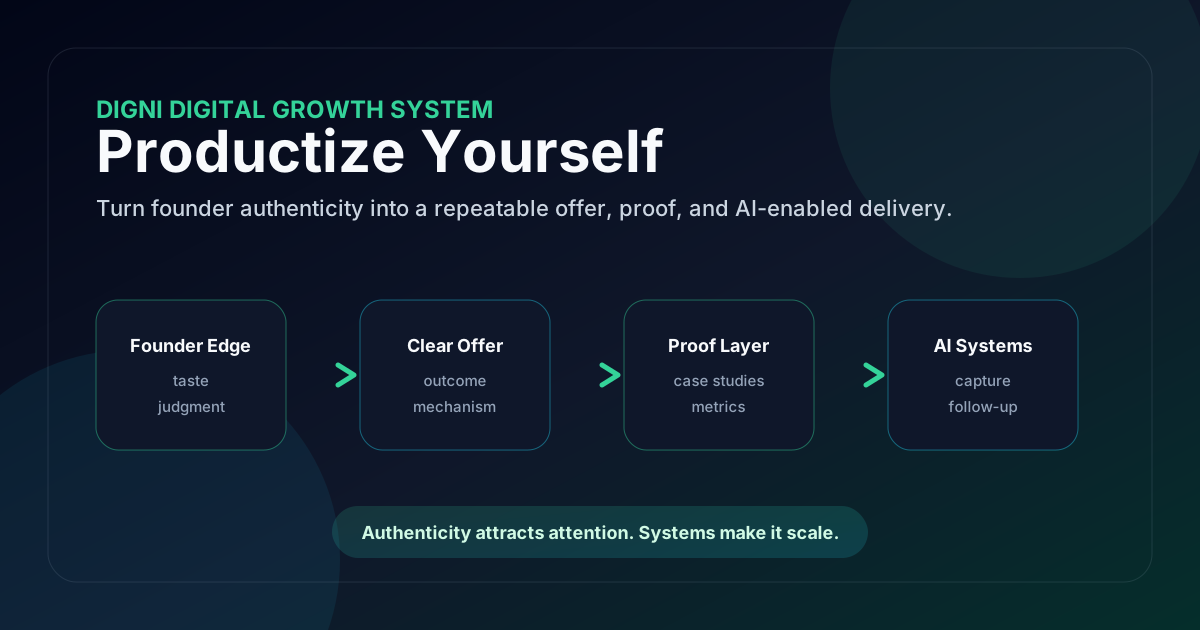
Simple frame: authenticity attracts attention, proof creates trust, and systems make the advantage scale.
Why traditional positioning fails
The broken model says: look at what competitors sell, copy the category language, add a few features, and hope buyers notice. That creates three problems:
- You become interchangeable, so prospects compare you mainly on price.
- Your team repeats generic scripts, so the customer cannot feel your standards.
- Your best thinking stays trapped in your head, so delivery depends on founder heroics.
The better model starts with a sharper question: what do you naturally notice, solve, or care about that your market already values? That is where differentiation begins. Productizing yourself means turning that edge into a clear promise, a defined process, proof, and delivery systems.
The productize yourself mechanism
At Digni Digital, we translate the idea into a practical operating model:
- Extract the founder edge: identify the decisions, taste, standards, and patterns that make your work different.
- Package the outcome: turn the edge into a clear customer promise with measurable value.
- Build the operating system: document the intake, qualification, handoff, delivery, and follow up steps.
- Add an AI execution layer: use AI reception, triage, summaries, follow ups, and internal tools to make the system available 24/7.
This is how a founder stops being the only person who can communicate the value. The business still carries the founder's standards, but the system handles more of the repetition.
Exploration before commitment
The reel also warns against premature commitment. That matters for founders because a polished offer built around the wrong market can trap you for years. Before you commit to a niche, test where three things overlap:
- Energy: the work feels engaging enough that consistency is realistic.
- Evidence: customers already pay for the outcome or feel the pain urgently.
- Edge: you have a credible advantage in how you solve it.
If one of those is missing, keep exploring. The point is not to wander forever; it is to avoid spending 30 years grinding inside a game you were never designed to win.
Case proof: from founder dependency to repeatable front office growth
One service business came to us with a familiar problem: the founder converted prospects well, but only when personally involved. Calls after hours were missed, inquiries were not qualified consistently, and the team did not always know which leads deserved immediate attention.
We mapped the founder's best questions, qualification standards, and follow up rhythm into an AI receptionist and lead qualification system. The result was not a generic chatbot. It was a front office layer trained around the business's real buying signals.
- Coverage: inquiries captured after hours instead of waiting until morning.
- Consistency: every lead answered with the same baseline quality.
- Speed: high intent prospects routed faster to the right person.
- Focus: the founder spent less time repeating intake questions and more time closing qualified opportunities.
That is the practical version of productizing yourself: not making the founder less important, but making the founder's best standards easier for the whole business to use.
How AI helps without flattening your originality
AI becomes dangerous when it makes every business sound the same. It becomes valuable when it protects what makes your business distinct:
- Voice: approved language, tone, and positioning built from how you actually sell.
- Judgment: clear rules for who gets routed, what gets escalated, and what needs human review.
- Memory: conversation summaries, CRM notes, and follow ups that keep context from disappearing.
- Measurement: dashboards that show response time, conversion, missed opportunities, and next bottlenecks.
The goal is not to automate your authenticity away. The goal is to automate the repetitive work around it so your strongest contribution reaches more customers.
A simple audit for your business
Use these questions before you add another tool or launch another offer:
- What do customers already thank you for that competitors treat as ordinary?
- Which founder decisions happen repeatedly but are not documented?
- Where do leads or customers wait because only one person knows what to do next?
- What proof can you show, such as response time, revenue lift, hours saved, or conversion improvement?
- Which repetitive step could an AI system handle without lowering trust?
Risk removal: start with one narrow system
You do not need to rebuild the whole company at once. The safest path is a narrow pilot: one audience, one offer, one intake flow, one measurable outcome. For many teams, that starts with lead capture, appointment booking, or customer triage because the cost of slow response is visible quickly.
If the pilot improves speed, consistency, and conversion, expand. If it does not, you learn before the change becomes expensive.
Next step
If you want to productize your founder edge without becoming the bottleneck, book a strategy call with Digni Digital. We will map your offer, identify the highest value workflow to systemize, and show where AI can support growth without diluting what makes your business different.
Inspired by Naval Ravikant's "productize yourself" principle: lean into what comes naturally, prove the value, then build the systems that let the market experience it consistently.
Tags
Ready to Turn Insight Into Action?
Whether you're building a business, guiding students, or finding your calling, let's discuss the next practical step.
Book Your Free Consultation